
Built in 1957 by oil baron and town founder Newton T. Bass and his business partner and brother-in-law Bud Westlund, the Hilltop House wasn’t just a home — it was a modern desert mansion perched on Miner’s Hill like Apple Valley’s crown jewel.
From its spot 300 feet above the Apple Valley Inn, it commanded a 360‑degree view of the valley, the mountains, and probably half the gossip in town.
It had that classic Bass flair: part showpiece, part sales pitch, part “look what we can build out here in the middle of nowhere.” It really did sit up there like royalty, a shimmering promise of what Apple Valley could become.
Apple Valley doesn’t just have history, it used to strut around with it like a cowboy who knows he looks good in a fresh pair of boots and sharply creased Wranglers.
But the irony is almost cinematic: the house that symbolized Bass’ vision for Apple Valley couldn’t find a buyer while he was alive. It sat there, elegant but unwanted, until his passing in 1983 at St. Mary’s Desert Valley Hospital, when it finally changed hands and underwent various, albeit temporary, iterations.

Hilltop House as viewed from the Apple Valley Inn during “Eight on the Lam” starring Bob Hope, Jonathan Winters and Phyllis Diller, 1967. Screen grab courtesy of Hope Enterprises/United Artists.
Sure, people think of Roy Rogers right away, and honestly, how could they not? The man practically adopted Apple Valley as his personal frontier.
If you lived here in the ’50s, there was a non‑zero chance you’d see Roy and Dale Evans at the grocery store buying beans or at the local bowling alley like regular folks, even though they were Hollywood royalty with better hats.
And then there’s the Apple Valley Inn, which was basically the High Desert’s version of a celebrity magnet.

This vintage postcard was taken near the Hilltop House. Apple Valley Inn is in the forefront. Courtesy Victor Valley College Library.
Back in its heyday, the Apple Valley Inn, which opened on Thanksgiving Day 1948, pulled in stars the way porch lights pull in moths, except these moths were named John Wayne, Bob Hope, Jayne Mansfield, Barbara Stanwyck, Desi Arnez, Lawrence Welk and Marilyn Monroe, to name a few.
Imagine checking in for a quiet weekend and realizing half of Hollywood beat you to the pool.
Roy Rogers leased the Apple Valley Inn and Country Club in 1965, later renaming it to Roy Rogers Apple Valley Inn when Dale Evans and their family became full-time Apple Valley residents.
Their final home, built in 1979 at 19838 Tomahawk Road, was a quiet, dignified desert retreat. The iron gates proudly displayed the Double R, a symbol that said everything without saying a word. It wasn’t flashy by Hollywood standards; but it was theirs — a little piece of frontier spirit tucked into the High Desert.

Jaylyn’s climbing the stairway to heaven…
Apple Valley’s heritage was this perfect blend of western grit, movie‑star sparkle, and “only in the desert” charm. It was the kind of place where a horse might be tied up outside a diner, and nobody would blink twice, they’d just ask if the horse wanted a table or a booth.
In the early hours of January 9, 1967, the Hilltop House met its first great catastrophe. A fire broke out around 4 a.m., and the timing couldn’t have been worse.
The night was so bitterly cold that pipes burst inside the house, and ice formed on the steep road leading up the hill, turning the approach into a frozen chute.
Fire crews tried to reach the top, but only one truck managed to claw its way up the icy grade. By then, the house was fully engulfed in flames.

Inside, Bass’ personal treasures, decades of mementos, documents, and artifacts — were lost. The house survived structurally, but its spirit took a hit it never fully recovered from. Brothers Michael and Keith Smith were charged with attempted burglary and arson.
Eventually, the 7,000 square foot Hilltop House became what the law politely calls an attractive nuisance, too iconic to ignore, too expensive to retrofit for earthquakes, and too tempting for trespassers.
Most people, however, weren’t there to wreak havoc. They were there to admire and wonder, to soak in the view, the mystery, and the strange magic of a mansion perched above Highway 18 like a desert crown.
For every skateboarder, graffiti vandal or bonfire bandit, there were dozens of curious locals, photographers, history buffs, and day‑dreamers who just wanted to stand where Newton T. Bass once stood and feel that same sense of possibility.
The Hilltop House had a way of turning even the most ordinary visit into a moment: the familiar sight of the water tower, the crunch of gravel underfoot, that first glimpse of the dramatically curved patio stairway and the wind swaddling the ruins like a blanket.

For most visitors, the Hilltop House wasn’t a playground or a dare — it was a pilgrimage.
Despite its slow decay, the landlocked Hilltop House held a strange dignity. Sitting high above the valley, it watched Apple Valley grow from a quiet ranching community into a full-fledged town, a silent witness to the very future Bass imagined.
It is doubtful that Bass ever envisioned a Walmart, built in 1996, in its shadow though.
The Hilltop House couldn’t seem to catch a break in its final decades. Another fire flared up in 2009, this one chewing through the carport and leaving behind the familiar scent of scorched timber that had haunted the property since the 1967 blaze.
It wasn’t a catastrophic fire, but it was another reminder that the old mansion was slowly losing its long battle with time, weather, and neglect.
Each new incident became another talking point, another round of “What do we do with this place?” discussed in council chambers, Facebook groups, and coffee shops across town.
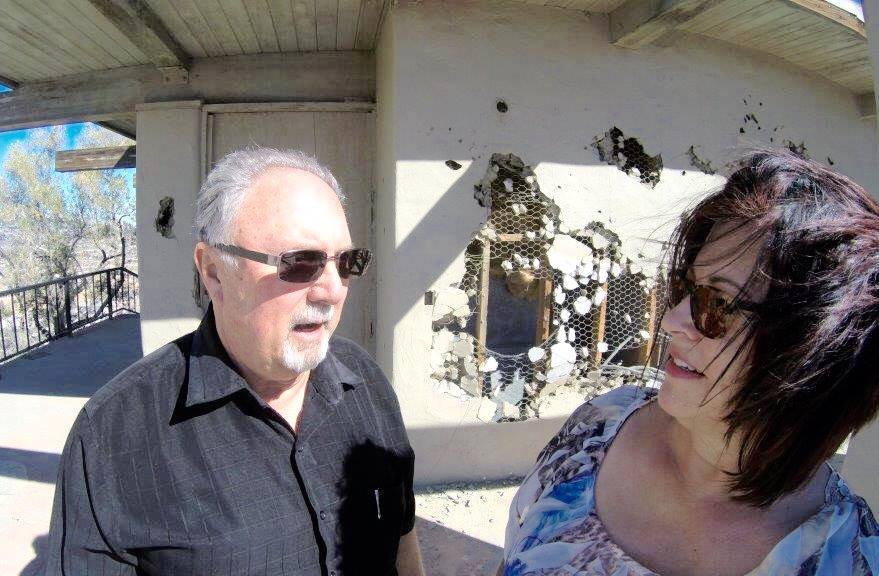
Jaylyn interviewed Apple Valley town councilman, Art Bishop, Mayor Larry Cusack and other local dignitaries at the Hilltop House in Apple Valley, February 2015.
Mayor Cusack, February 2015. City reps were excited about Hilltop House’s future possibilities.
When the Town of Apple Valley purchased the Hilltop House in 2016, there was a brief moment of hope that offered protection against out-of-area commercial developers and further vandalism.
They fenced it off, posted a security guard, and for a while it seemed like the Hilltop House was at last being treated less like an abandoned relic and more like a fragile artifact from a bygone era. Alas, appearances can oftentimes be deceiving. Six long years passed.
The final coffin nail wasn’t hammered in by the natural reclamation processes of the desert; it was delivered by local leadership choices that treated a landmark like an inconvenience instead of an historic asset.

For many, the Hilltop House wasn’t just a building. It was a battleground of values — nostalgia versus pragmatism, heritage versus liability, hope versus exhaustion.
Despite a loud and heartfelt push from visionaries who wanted to see it restored, repurposed, or at least allowed to stand as a historical marker, the town made the call to demolish it.
In March 2022, the Daily Press reported the estimated price tag to raze the town-owned structure would be to the tune of $150,000 to $200,000 using abatement funds and allocated Community Development Block Grant funding.
The Town of Apple Valley had already spent $160,000 to buy the Hilltop House — money that came from a Federal Park Grant meant to protect Bass Hill, not turn it into a cautionary tale.
And what did residents get for that investment? A handful of empty promises, a bucket of dashed hopes, and metaphorical front‑row seats to the demolition of the very landmark they were told would be preserved.
Later that same year, with one fell swoop of the excavator, decades of Apple Valley history became dust on the wind.
The Hilltop House didn’t fall because of inevitability — it fell because of flawed political decision‑making, the kind that comes wrapped in meetings, memos, and a remarkable ability to ignore a town’s own history.

Photo courtesy of Donald M. Frazee DC, September 12, 2022.
Steve Richard, a local architect and Legacy Trail advocate stated, “Ruin resolution was well documented as a predictable outcome. For me, the sad fact was gas lit by the city fathers not including the community in the cultural loss. Cultural impact was obvious and cited by a report with same name.
It’s why the high deserts most unique property sits as a quagmire today without even trash cans, dog poop patrol or unlocked access gates.
Instead, Historic parts and pieces of the fossil were harvested for gifts to a select few at Town Hall. A VIP remembrance rather than a community event to remember the past, while looking forward to future public use as promised.
Bass Hill stewardship of ownership – since Bass – has been a sad story in my view.”
Note: Apple Valley Legacy Trail did not own any of the property in their proposal.
Protecting Apple Valley’s history isn’t about nostalgia — it’s about community identity, economic value, and respect for the people who built this place. Although some saw Hilltop House as an eyesore, traditionalists were reluctant to watch another familiar landmark disappear.

Hilltop House above Apple Valley Inn, 1961. Courtesy, Los Angeles Public Library. Kelly-Holiday Collection.
If Apple Valley wants to preserve future cultural management, it doesn’t need a miracle — it just needs fewer decision‑makers who treat historic landmarks and relics like items on a yard‑sale table.
Voting is one of the most powerful ways to do that — not by targeting individuals, but by supporting people who consistently show they’re invested in the town’s future, balanced with the thoughtful preservation of its past.
2026 is an election year for the Apple Valley Town Council. Three seats will be on the ballot, including two Council Members and the Mayor.

Still, the Hilltop House left behind a kind of mythic afterglow. Locals remember the view, the architecture, the mystery, the vandalism, the parties, the lore and the “what ifs.”
Even in absence, the Hilltop House remains part of Apple Valley’s core memories.

Composite courtesy of CRMLS.
The gentrification of Apple Valley continues. As of March 2025, the former Hilltop House property at our old stomping grounds in Apple Valley was for sale at $7,799,000 for the 99.47 acre lot. As of January 9, 2026, it remains unsold.
Like most stories, there are always two sides. If you want take a deeper dive into the town of Apple Valley’s amazing history, we highly suggest you visit Apple Valley Legacy Museum, located in the Apple Valley Inn casita offices at the Bob Hope building.
Top Aerial Photo courtesy: Los Angeles Public Library, Howard D. Kelly, 1960.
All other photos, except where indicated otherwise, were taken by Jaylyn and John Earl.
Last updated: February 24, 2026.
Resources
Elgin, Fran, Index to Mohahve Books I-V, published between 1963-1991, Mojave Copy & Printing, Inc., 2016.
Lyman, Edward Lee, History of Victor Valley, Mohahve Historical Society, 2010.
O’Rourke, Katie, The History of Apple Valley From Early Man to 2004, Lewis Center for Educational Research, second printing 2012.
Hilltop House Forum/Legacy Trail https://www.facebook.com/AvHilltopHouseForum
Mohahve Historical Society https://www.facebook.com/profile.php?id=100076991074853
I’d love to be able to print out this article to pass out at our store, Bygone Belongings, LLC to interested customers. Can I get a pdf of it!
Hi Richard! Of course! We’re honored. I’ll send you a .pdf in the morning. Thanks ~Jaylyn
Thank you for having this article on your site. I was recently researching the house for a history project and was surprised to find the Town had deleted all references and record to the Hilltop House.