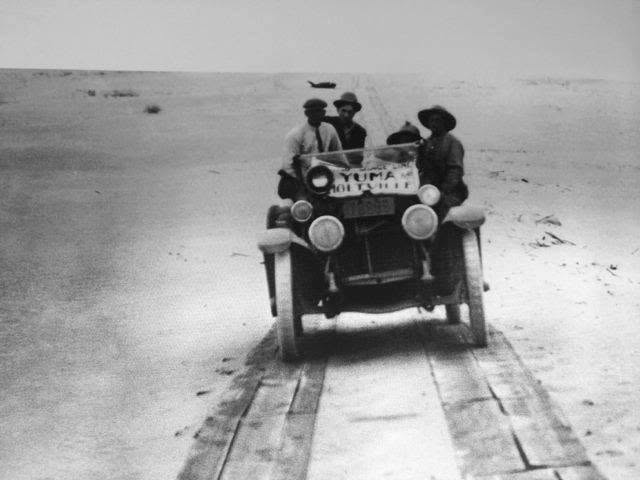
The shifting sands of the Imperial Valley were not just an obstacle; they were a force of nature that swallowed early automobiles whole. By 1913, the challenge had grown so dire that the Auto Club of Southern California summoned all interested parties to El Centro, demanding a solution for a road that could carry travelers from El Centro to Yuma and beyond.
Rival visions clashed. Brawley pushed for a route through the desolate Mammoth Wash, while Holtville championed a bold strike straight across the blistering expanse known as the American Sahara. San Diego’s fiery civic leaders, led by the relentless Col. Ed Fletcher, proposed the most audacious idea of all: a road built from prefabricated wooden planks, laid like a lifeline across the dunes.
Fletcher, already a visionary in shaping Southern California’s future, was simultaneously driving monumental water supply projects for San Diego, including the creation of Lake Hodges, a reservoir that would change the region’s destiny.
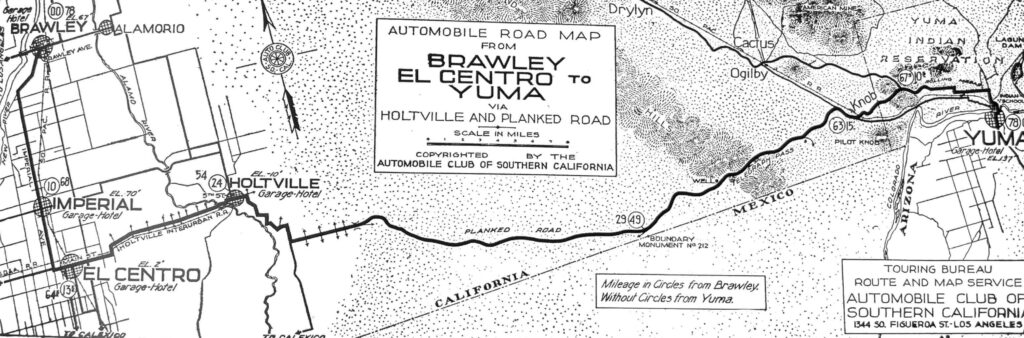
Photo Courtesy: Automobile Club of Southern California
The Los Angeles Examiner proposed a contest to determine the most practical route to Phoenix. The paper dispatched one of its reporters from Los Angeles with a full twenty‑four‑hour advantage, while Fletcher set out from San Diego.
In making his way east, Fletcher chose to cross the shifting desert dunes, employing a team of horses to pull his automobile through the heaviest stretches of sand. Despite the difficult conditions and the handicap at the start, he reached Phoenix in 19.5 hours, a time that astonished observers throughout the region.
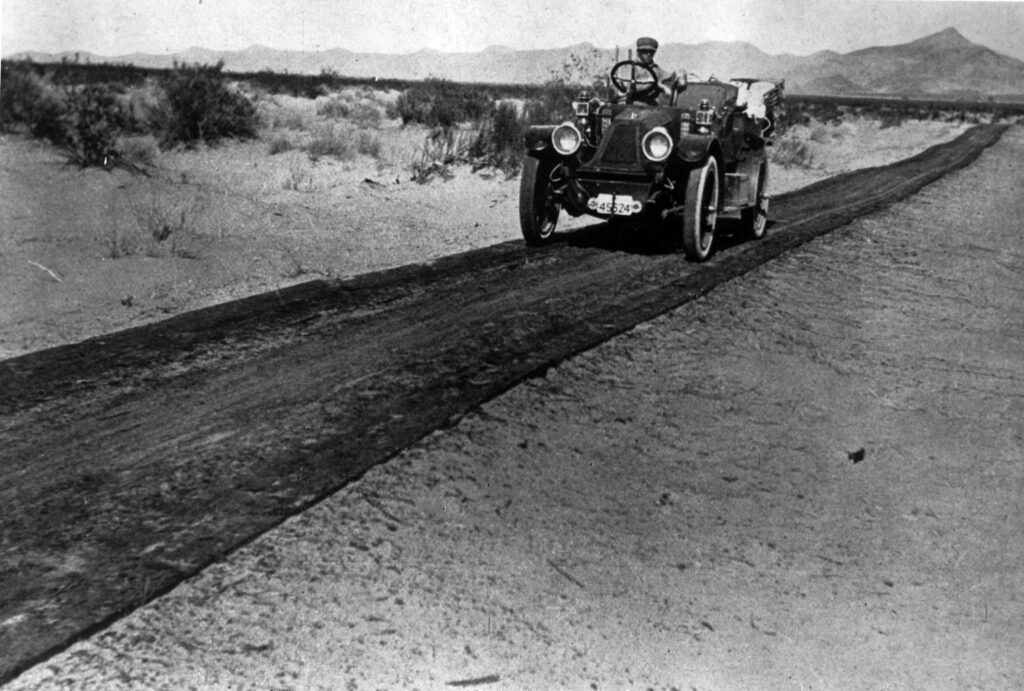
Photo Courtesy: Bureau of Land Management California , Public Domain.
Imperial County rallied behind the plank road crusade, feeding the crews and covering freight and haulage from Ogilby. Workers poured in from every valley town, carving out a rough and ready camp at the site now known as Gray’s Well, a lonely outpost that became the staging ground for one of the West’s most improbable engineering feats.
From surviving accounts, it is clear that labor on the plank road was anything but predictable. On some mornings as few as ten men reported for duty, while on others as many as fifty assembled at the site, and there were days when no workers appeared at all.
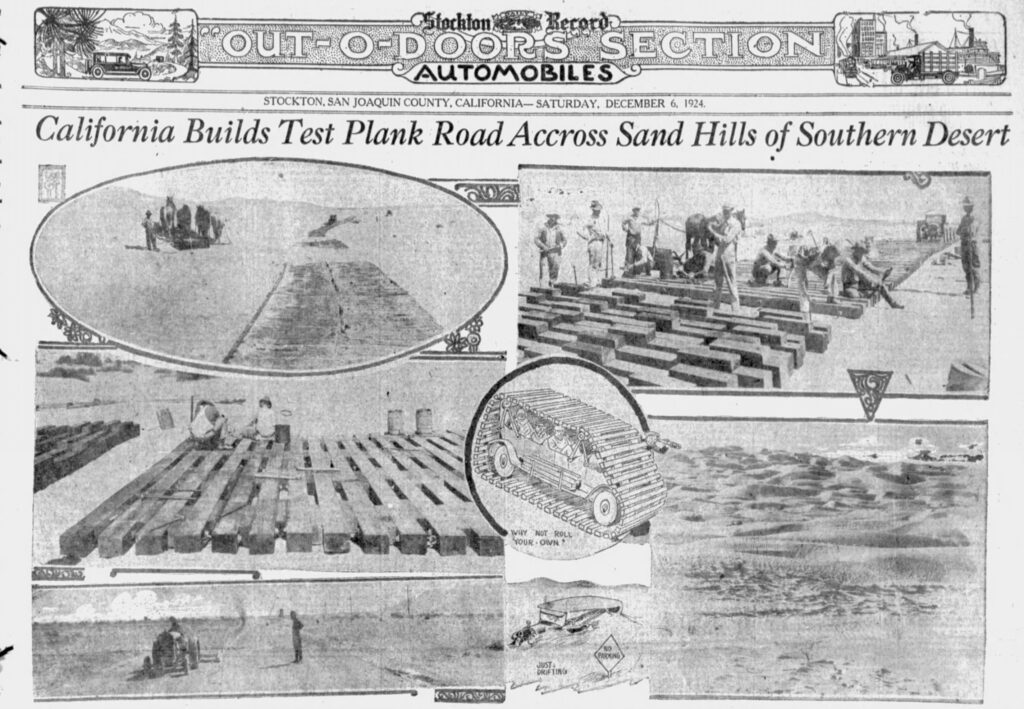
The Record, December 6, 1924.
Despite this irregular workforce, the crews succeeded in laying approximately 13,000 interconnected planks, creating an eight‑foot‑wide single‑lane track that represented one of the earliest attempts to impose order on the mercurial sands of the Imperial Valley.
Because the road was single-lane, double-width turnouts were installed every 1,000 feet so oncoming cars could pass one another. The whole project cost a total of $25,000 dollars. Finally, after six months of discouraging work, the plank road was completed in 1915. A second, more sophisticated Plank Road was commissioned in 1916.
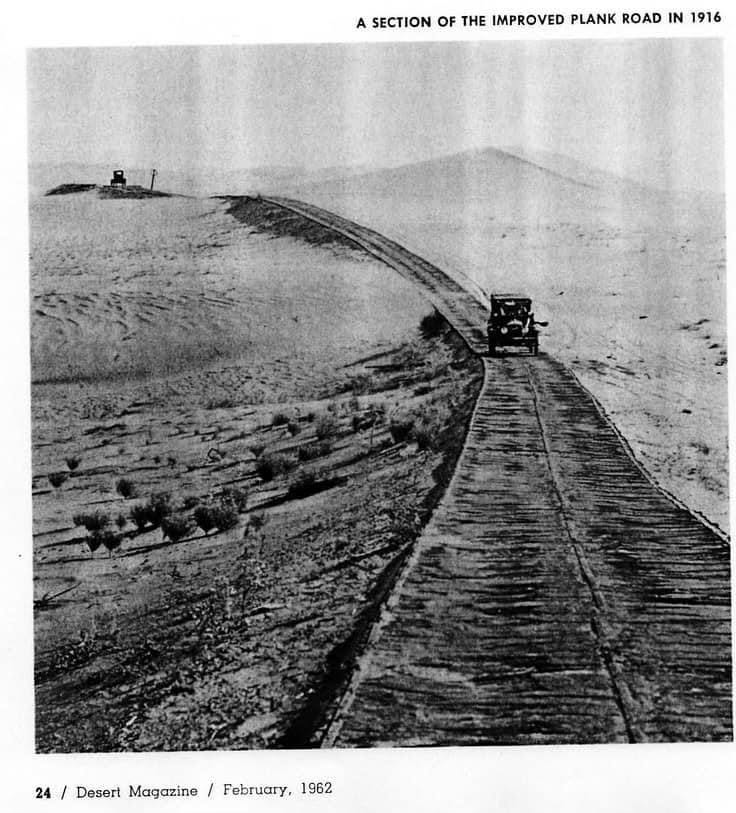
Harsh winds constantly buried the road in sand. Teams of horses were frequently used to drag heavy wooden replacement sections into place and pull trapped vehicles out of the dunes. Serving as a vital commercial link between San Diego and Yuma, it was eventually replaced by paved highways in 1926. Efforts to preserve the historic plank road began almost immediately.
In 1934, Fletcher was elected to the California State Senate, and served until January 6, 1947.
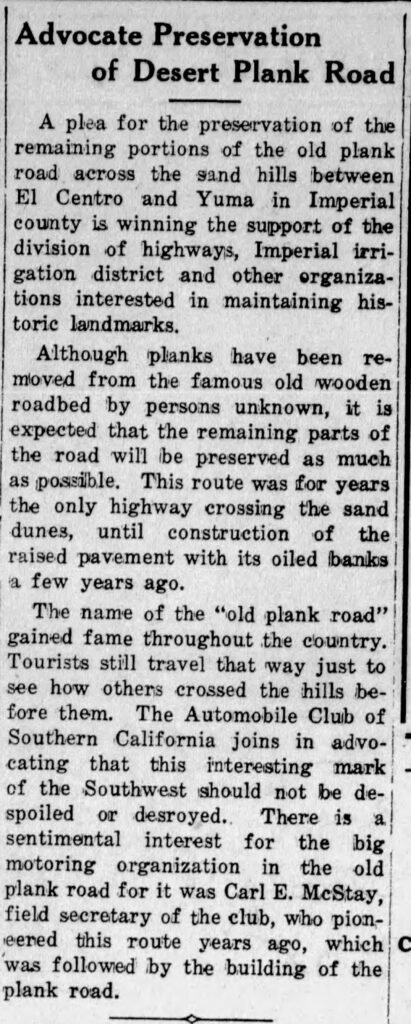
The Perris Progress, July 31, 1930.
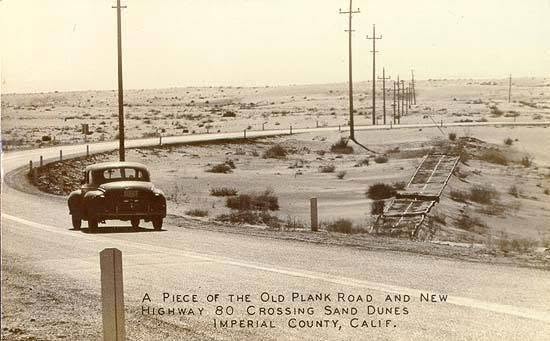
1940s Postcard.
Fragments of the original six‑and‑a‑half‑mile wooden roadway can still be found scattered across the Algodones Dunes of Imperial County. The Bureau of Land Management has preserved and reconstructed a 1,500‑foot section of this early desert highway in 1971, and it now stands as a designated California Historical Landmark, offering a rare glimpse into one of the region’s most unusual transportation experiments.
The Colorado River State Historic Park in Yuma has a Plank Road display with a Model T automobile.
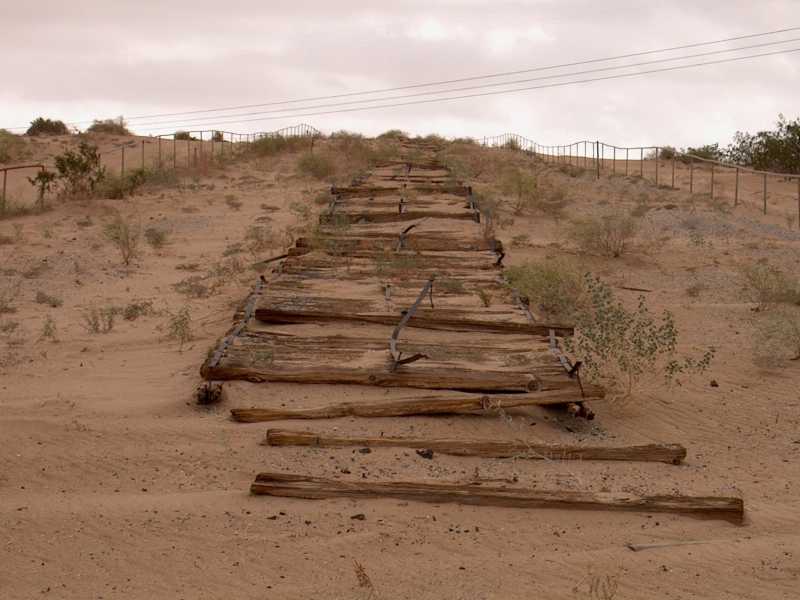
Photo Courtesy, Perdelsky at English Wikipedia – Public Domain.
Directions: Off Grayswell Road, approximately 18 miles west of Winterhaven, California, and just north of Interstate 8.
Top Photo Courtesy: Bureau of Land Management California , Public Domain.
Recommended Resources
Fletcher Family Tragedy in Borrego Springs https://www.sandiegoreader.com/news/2025/oct/13/fletcher-family-tragedy-in-borrego-springs
Old Plank Road https://en.wikipedia.org/wiki/Old_Plank_Road
Plank Road, Historical Monument: https://ohp.parks.ca.gov/listedresources/Detail/845
AZ DOT Plank Road: https://azdot.gov/adot-blog/plank-road-was-once-way-between-yuma-and-san-diego