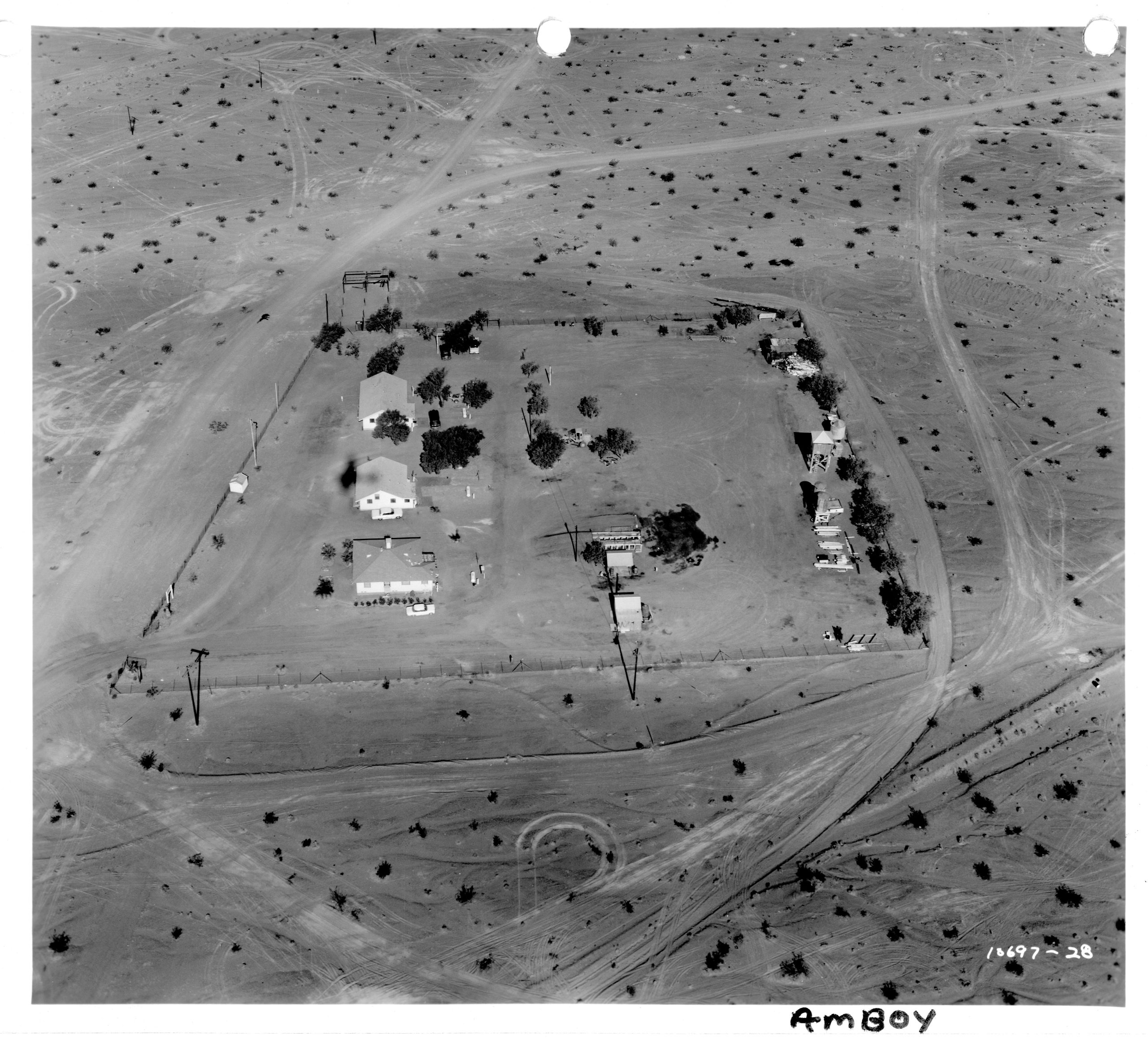
At the northwest corner of Waalew Road and Dale Evans Parkway in Apple Valley, just across the road from the Los Ranchos Mobile Home Park, is a vacant piece of desert with a few cement foundations and a smattering of trees near Bell Mountain.
Next time you drive by there you might want to know that in the 1940s and 50s it was a working ranch of a special sort. Known as “Murray’s Ranch,” and “The Overall Wearing Dude Ranch,” it was African-American owned and operated in the Bell Mountain community.

California Eagle, Sun, Aug 29, 1937
According to The History of Apple Valley by Katie O’ Rourke, Murray’s “Overall Wearing Dude Ranch” was the only African-American dude ranch in the United States, and the only ranch in the area to be written about in Life magazine at the time.
The earliest Black homesteaders received land patents in 1914 in the area known as the Bell Mountain District. By the 1940s there were 37 families in the settlement.

Murray’s Dude Ranch, Apple Valley, courtesy San Bernardino County Museum.
The 40-acre ranch on the edge of the Mojave Desert was purchased by Nolie B. and Lela Murray in 1922 for $100 dollars from the Cook family, and operated for nearly 20 years.
Prior to moving to the desert for Lela’s health, Nolie owned Murray’s Pocket Billiard Emporium and Cigar Store in Los Angeles. Their dream was to build a better world for underprivileged Black children.

U.S., World War I Draft Registration Cards, 1917-1918 for Nolie Benjamin Murray
The Murray’s story is truly one of passion, tenacity and perseverance during an ugly part of American history.
After selling his business, Nolie rolled up his sleeves and his dream of helping others slowly came to fruition. Eventually the fenced property featured twenty buildings, a swimming pool, tennis courts, riding stables, a dining hall and a ball field.

Postcard depicting Nolie and Lela Murray, owners of Murray’s Dude Ranch, Victorville, courtesy UCSD.
The ranch catered to troubled children, no matter their race. Courts sent some of the children to the ranch, but children suffering health issues also came to soak up the sun, activities and good will.
Lela was a registered nurse and made a specialty of caring for children suffering respiratory ailments.
No matter how good their intentions were though, the ranch struggled financially to make ends meet. Then things changed practically overnight.

California_Eagle_Sept 30, 1937
A spotlight fell on the ranch in 1937 when Life magazine featured Murray’s Ranch in their November 15, 1937 issue.
The unexpected notoriety happened when heavy-weight boxing champion of the world, Joe Louis, was one of the attendees at an amatuer rodeo in Victorville, a town of about 2,000 people. The event attracted 10,000 spectators and celebrities to the small desert town.

A Life magazine photography crew was in town to cover the rodeo. Joe happened to be staying at Murray’s Ranch and the large throng of curious rodeo fans followed him there. A giant picnic in the desert ensued.
After Joe’s visit, financial stability at the ranch improved dramatically. Suddenly, Murray’s Ranch became a destination. The Murray’s debt problems were over.
Celebrities such as ex-boxing champ Henry Armstrong, Mary McLeod Bethune, Bill “Bojangles” Robinson, Lena Horn, Kate Smith and Hedda Hopper visited the ranch.
The ranch’s fame was still going strong a decade after its grand entry in Life. Murray’s Ranch appeared on the cover of Ebony magazine in the February 1947 issue.

Murray’s hosted about 100 people each week during the height of the season, from May to September.
Lela’s favorite guests remained the troubled and ailing youth from cities who visited the ranch and benefitted the most from their deset sojurn.

California Eagle, May 22, 1941
The ranch became the setting for western films of the era, including two of Herbert Jeffries’ “all-Black cast” westerns.
Jeffries, known as the singing cowboy, was the star of The Bronze Buckaroo (1939), and Harlem Rides the Range (1939).

Photo courtesy of Apple Valley Legacy Museum.
Murray’s also served as a getaway for film and radio celebrities of all backgrounds. Everyone appreciated the Murrays’ warm hospitality and Lela’s homemade cooking.
Lela Murray died in 1949 at the age of 58. Six years later, Nolie married Los Angeles school teacher Callie Armstrong.
In 1955, the ranch was purchased by none other than Pearl Bailey and her husband, Louis Bellson, for nearly $65,000. They were former visitors of the ranch and became smitten.

Pearl Bailey and Louis Bellson, 1952, courtesy familysearch.org/
Pearl Bailey had fallen in love with the area and desert ambiance; after they bought the ranch they renamed it the “Lazy B.” Their marriage was notable as an interracial union during a time when such relationships were uncommon, and they remained together for 38 years until Bailey’s passing in 1990.
The Murrays kept five acres and built and managed a motel until Nolie’s death in 1958 at the age of 70.
Bailey took to desert life by joining the Apple Valley Chamber of Commerce and became a den mother to a local Girl Scout troop. She lived at the ranch for nine years.

Daily Press Thu, Jun 16, 1955 ·Page 1
Pearl Bailey sold the Lazy B Ranch to her nephew, Bill Lewis. Later in the 1980s, he sold it to Jay McVeigh. The ranch evolved into a body building gym.
By the 1980s, the ranch was virtually forgotten. In 1988, it fell into receivership to San Bernardino County. No effort was made to preserve its important history. The buildings were intentionally burned to the ground in a fire fighting exercise.
Eventually most of the irreplaceable historic ranches of Apple Valley were torn down in the name of progress. Kemper Campbell Ranch and Hilltop are still active to this day.
Was Murray’s Dude Ranch indeed the only black dude ranch in the world, as their postcard boasted? The short answer is ‘no.’ One has to admit it was a catchy slogan though. We surmise the Murray’s postcard was merely an early advertising gimmick and likely not meant to disregard Ms. Raglan’s Guest Ranch just a few miles away.
Murray’s Ranch (1938-1958) is a Green-Book site on Route 66. The Smithsonian Greenbook exhibit just finished a five year tour around the country. Lily Raglan’s former guest ranch (1949-1957) on Quarry Road at Harris Lane in Apple Valley is also listed as a Green-Book site.

The Negro Motorist Green Book, 1947.
The historic Negro Motorist Green Book was a travel guide for African Americans during the Jim Crow era. It was created by Victor H. Green, a black postal carrier from Harlem. The Green Book was published from 1936 to 1966.
Many Black Americans preferred traveling by automobile, in part to avoid segregation on public transportation in order to be free of discomfort, discrimination, segregation and insult.
According to Courageous Motorists: African Americans Pioneers on Route 66, the far western end of Route 66, the Los Angeles area had been home to thousands of African Americans since the 1890s. In 1897 white assemblyman Henry Clay Dibble led the state legislature to pass a bill guaranteeing equal access to public accommodations.
The advocacy of Frederick Madison Roberts, California’s first black assemblyman, helped strengthen the law in 1919 and 1923.
The Supreme Court case Brown v. Board of Education in 1954 overturned the 1896 Plessy v. Ferguson decision. Brown v. Board of Education declared state-sponsored segregation in public schools unconstitutional, effectively dismantling the “separate but equal” doctrine established in Plessy. Yet, segregation in public areas continued.
Further progress was made with the passage of the Civil Rights Act of 1964, which outlawed discrimination based on race, color, religion, sex, or national origin in public accommodations, facilities, and employment. The Voting Rights Act of 1965 also played a crucial role by prohibiting racial discrimination in voting.
Marcy Taylor, historian, local expert on the Murray Ranch, and owner of Apple Valley Legacy Museum, called the former Murray’s Ranch “a true gem for Black travelers in the long, hot, barren desert.” Marcy has spent years learning about the ranch’s rich history and is a frequent presenter about the topic. Her museum contributed artifacts to the traveling Smithsonian Green Book exhibit over five years ago.
It is sad this site does not have a historical marker in the vicinity noting the importance of Murray’s Ranch and its cultural significance.
Are you listening, Clampers?
Top Photo: Murray’s Ranch in the 1950s, superimposed over the open desert before a housing development was built near Bell Mountain. Photo by John Earl.
References
Briggs, Randy, African Americans and the High Desert, A Brief History, Mohahve VI, pub Mohahve Historical Society, pub. 2012, pg 63-67.
Lyman, Edward Leo, History of Victor Valley, Mohahve Historical Society, pub. 2010, pg 244–245.
Norris, Frank, Courageous Motorists: African Americans Pioneers on Route 66, New Mexico Historical Review, Vol. 90, pub. 2015, accessed Aug 17, 2025. https://digitalrepository.unm.edu/cgi/viewcontent.cgi?article=2558&context=nmhr
O’Rourke, Katie, The History of Apple Valley. Lewis Center for Educational Research. pub. 2004, pg. 30–31.
Thompson, Richard, Murray’s Ranch, the Bronze Buckaroo and a ‘Mystery’ Celebrity Owner, The Mohahve Muse, Vol. 5, Issue 3, pub. March 2002.
Harlem Rides the Range, a 16mm release print of the feature film. It consists of two reels of positive, black-and-white, 16mm acetate film strips with variable-area optical sound (58 minutes) https://nmaahc.si.edu/object/nmaahc_2015.167.9.1ab Note: Bronze Buckaroo filmed at Murray’s Ranch is also available on this site.
Lela Murray https://www.findagrave.com/memorial/7871736/lela-murray
Nolie Murray https://www.findagrave.com/memorial/7955486/nolie_benjamin-murray
Richard Thompson https://www.vvdailypress.com/obituaries/p0210449