On February 16, 1867, the quiet expanse of Rabbit Springs Dry Lake in Lucerne Valley erupted with vengeance. Three years after the Las Flores massacre, another clash flared. What followed was less a battle than a sudden strike: a posse of settlers descended on a small Indigenous band—likely Serrano—wrongly believed to be Southern Paiute (Chemehuevi) responsible for recent attacks in the nearby mountains.
It has been cited as the last skirmish between Native Americans and European settlers in California. The world that native people knew was coming to end, and reservation life would sadly be in their futures.
In 1863, violence struck where Lake Arrowhead is today. A Spanish man named Polito fell beneath Chemehuevi arrows, and the raiding party vanished into the desert, driving off a mule stolen from Sam Pine, slaughtering it for meat as they fled. Soon after, they shot down a horse and mule belonging to W. F. Holcomb and Pete Smith. Around that same time, the Indians ambushed Dr. Smith in Cajon Pass, leaving him wounded but alive.
Bill Holcomb rallied a posse and pushed into the desert after the raiders, but the pursuit collapsed when their provisions ran out. In Cajon Pass, another strange incident unfolded: S. P. Waite, firing at something a blue jay was diving toward, unknowingly shot an Indian. Only with daylight did he realize what he had done.
By 1866, the danger had crept back into the mountains. J. W. Gillette, Ed Parrish, and Nephi Bemis rode out from the Dunlap Ranch to gather stray cattle. Gillette’s mule gave out, so he turned back to fetch Pratt Whiteside. Gillette stayed behind with Whiteside’s herd.
Then the horses of Parrish and Bemis came thundering home without their riders; Parrish’s saddle smeared with blood. Gillette raced to the ranch house to alert the sick Bud Dunlap and gather armed men.
They found young Bemis at sundown on March 2, 1863. The ground around him told the story: thirty to forty Chemehuevi warriors had overwhelmed him. Whiteside and Parrish were found the next morning. Parrish still clutched a stone, the last weapon he had managed to grab. The Indians had stripped all three bodies and taken Whiteside’s rig and pistol. That night, they slipped back into the desert after eating Whiteside’s horse.

Winter of 1867 brought them again. They swept through Little Bear Valley, looting homes, then struck the place of Bill Kane, stealing the horses, supplies, and guns of George Lish and John Dewitt.
At dawn, Frank Talmadge, Jonathan Richardson, George Armstrong, and Bill Kane rode out after them. When they returned to Kane’s home, they found only ashes—everything the Indians could not carry had been burned or smashed.
The families were moved to safety at the mill, and riders from San Bernardino were already on their way. Fresh snow had fallen overnight, whitening the mountains and desert floor. It made the raiders’ trail stand out sharply, and the men pressed on, following the prints toward whatever waited ahead.
The Indians were hidden behind a fallen log, silent and waiting. Bill Kane rode almost directly over them without realizing it. A sudden crack of gunfire shattered the stillness—Kane’s horse dropped beneath him, throwing him hard to the ground. His rifle flew from his hands, leaving him with only his pistol.
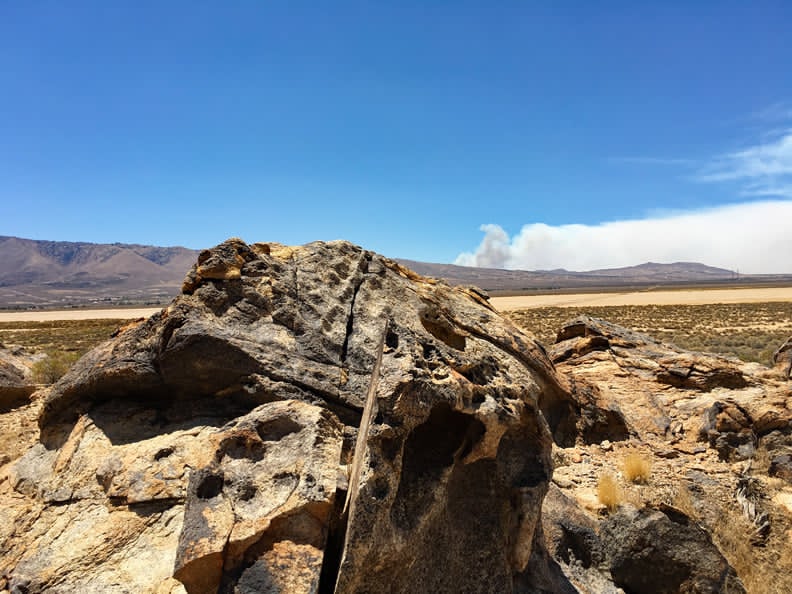
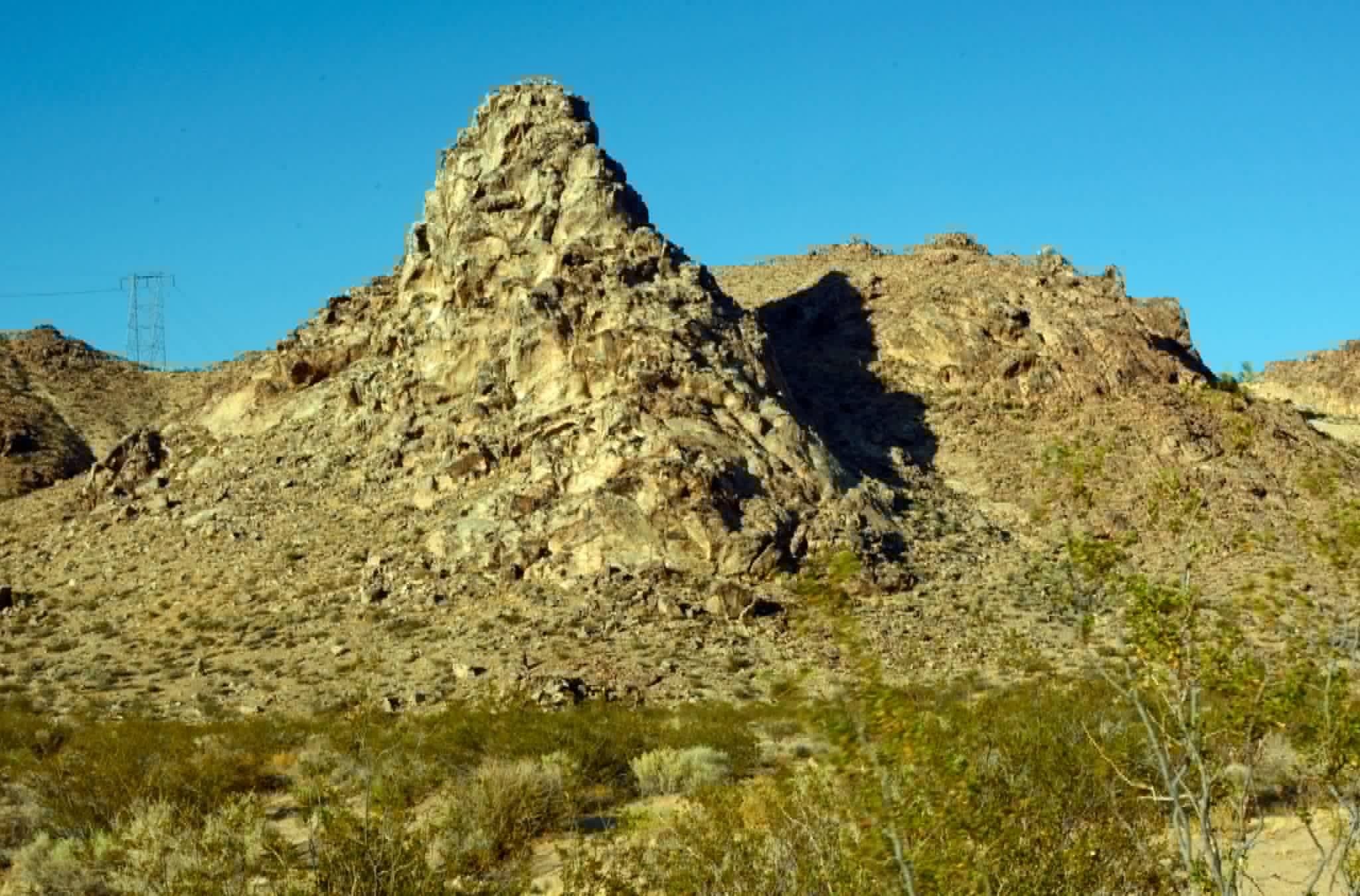
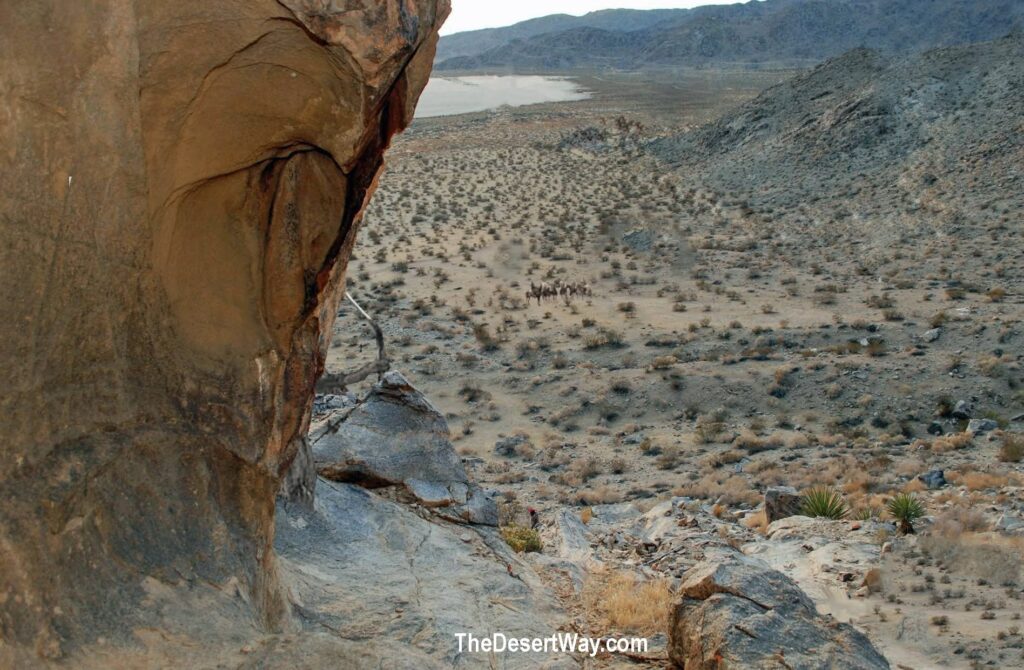
View from the top of Chimney Rock with Rabbit Springs Dry Lake in the distance, 2016.
The Indians closed in, trying to finish him where he crouched behind a tree. At the last moment, Frank Talmadge burst onto the scene, firing as he came. His shots dropped one Indian, and the rest scattered into the timber. With the danger momentarily broken, the men retreated to the mill to gather ammunition and more fighters.
By dawn, Talmadge, Kane, Jonathan Richardson, and George Armstrong had been joined by William Caley, A. J. Currey, Tom Enrufty (“Noisy”), Henry Law, George Lish, Tom Welty, Frank Blair and Joab Roar.
In the thick timber atop the first ridge beyond the mill, the posse met a force of nearly sixty Indians. The air erupted with gunfire and the hiss of arrows. For a long, punishing stretch, the ridge shook with hundreds of exchanged shots. At last, the Indians gathered their wounded and slipped toward the desert, fading into the trees and rock.
The posse did not pursue. They carried their own wounded back down the ridge—Tom Welty shot through the shoulder, Bill Kane hit in the leg. Only one Indian had been killed, but the fight had carved its mark on everyone who survived it.
More riders thundered up from San Bernardino, bringing fresh ammunition, hard tack, and the grim resolve of men who knew the desert well. With their numbers swelling, the posse split—one column forcing its way through the jagged mountain passes, the other sweeping down through the narrow throat of Cajon Pass. They regrouped at the Dunlap Ranch on the Mojave River, forming a single determined force.
Riding beneath a cold sky, the men gathered: Jack Ayres, Samuel Bemis, Edwin Bemis, Bill Bemis, Harrison Bemis, Frank Blair, George Birdwell, Sam Button, George Armstrong, W. F. Holcomb, Jack Martin, John McGarr, Joseph Mecham, George Miller, John St. John, Bart Smithson, Johnathan Richardson, and an unidentified man whose name was lost to time.
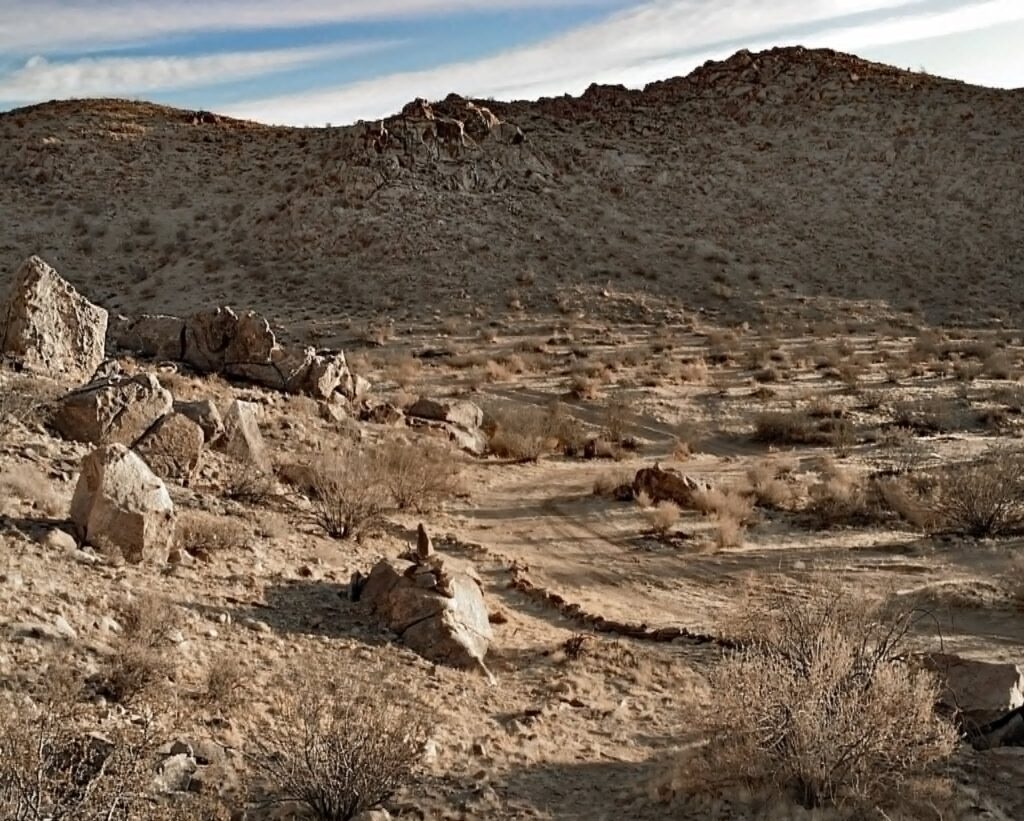
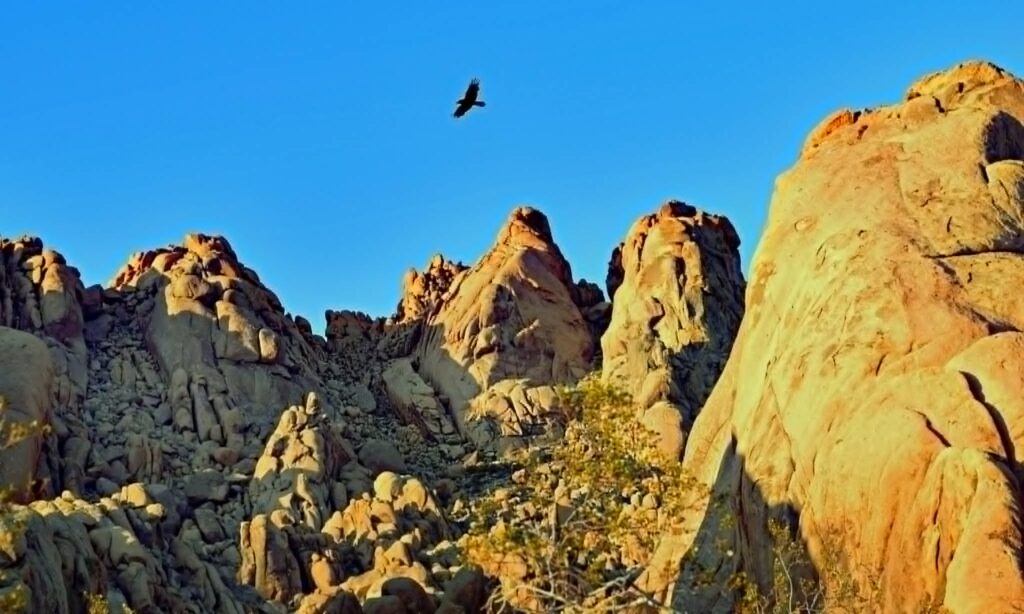
They found the Indians entrenched high on a rocky mountain northwest of Rabbit Springs, the stone rising like a fortress above the desert floor. The climb was brutal, and three or four men fell sick and had to turn back. But the next morning, more riders appeared—armed, and ready to join the chase: Tom Enrufty (“Noisy”), Griffith, George Lish, Preacher Stout, Stout’s son, Stout’s son‑in‑law, and David Wixom.
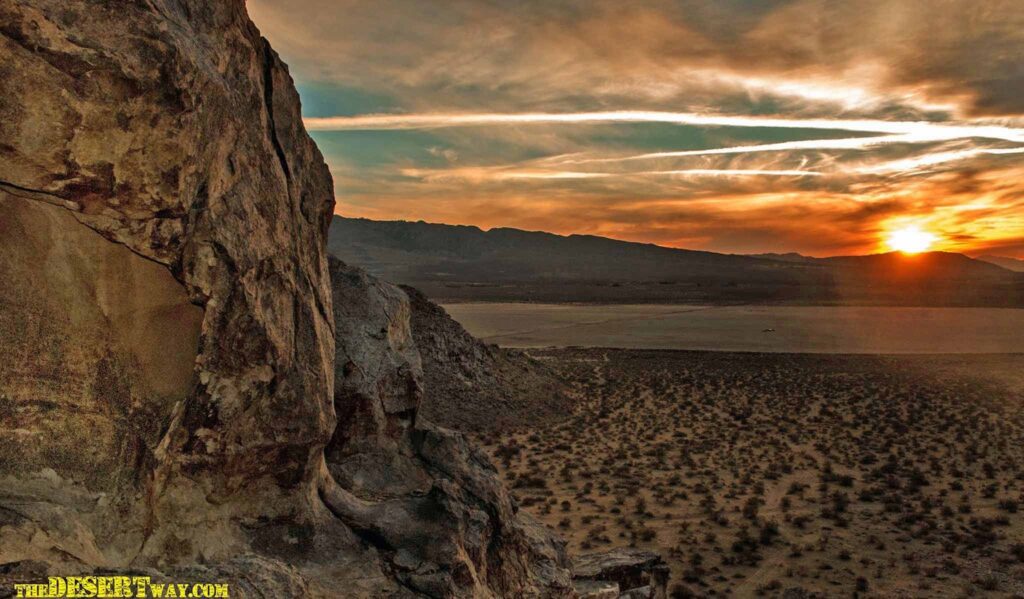
Our photos depict a great vantage point to watch for an approaching posse out for revenge in 1867. The Battle of Chimney Rock, known as the last Indian Battle in southern California. Down on the desert floor, Billy “Grizzly Bill” Holcomb rode at the head of a worn‑thin posse drawn from Belleville and the scattered mining settlements of the high country.
For over a month they had followed the faint, wind‑scoured trail of a small Chemehuevi band, tracking them across dry basins and stony ridges to a lonely place near a barren lakebed called Rabbit Springs.
With the reinforcements, the posse grew into a restless frontier army—men hardened by the Mojave, now gathered beneath a rocky stronghold where the next clash waited.
The Indians were waiting for them. Hidden among the rocks above a narrow pass, they held their fire until the posse rode into the choke point—then the canyon exploded with gunshots and the hiss of arrows. The men wheeled their horses and returned fire, the echoes rolling off the stone walls. Under the sudden fury of the exchange, the Indians scattered back into the rocks, leaving the pass choked with dust and gun smoke.
In the chaos, Stout’s son‑in‑law was hit. The men carried him back to camp, his blood marking the trail behind them. It was clear he needed to be taken to San Bernardino for treatment, but sending riders to escort him would strip the posse of too many men. With their numbers too thin to continue the fight, the decision was made: the pursuit would end.
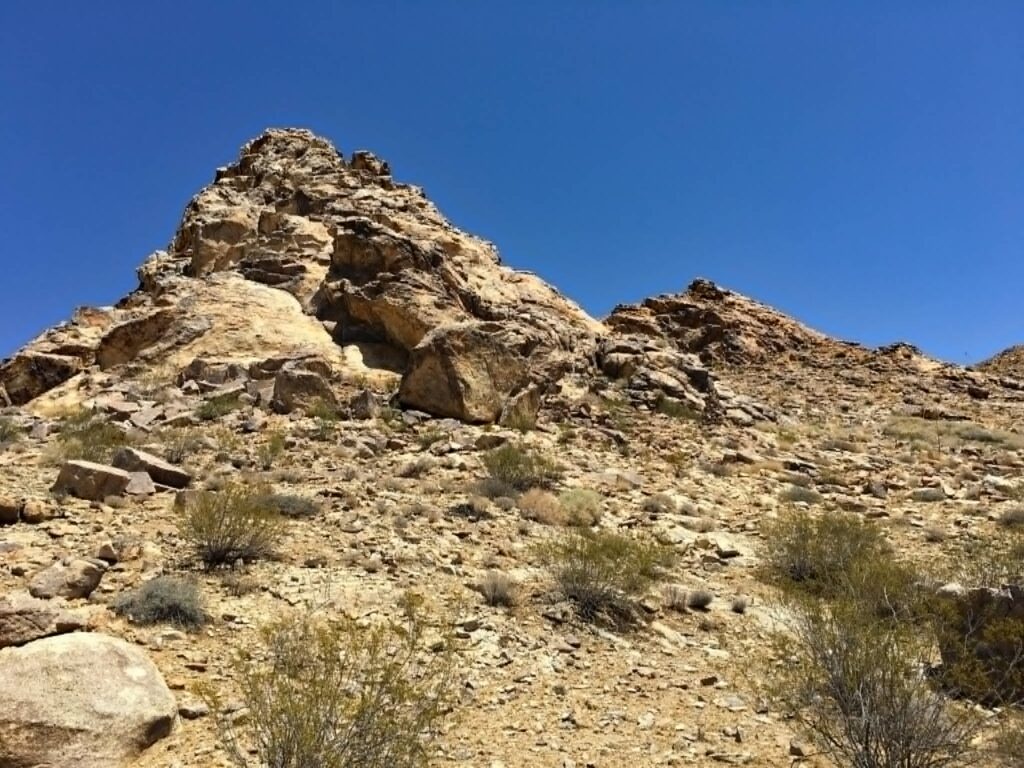
Bitter cold and storming in the mountains quelled the men’s spirit for fighting. They had not had a homecooked meal in over a month.
After thirty‑two relentless days—through mountains, passes, snow, and desert—the long campaign against the raiding parties came to a close. The Indians withdrew from the high country, and their mountain forays ended with the fading echoes of that last ambush in the boulders.
Hidden on the ragged hillside, a lone Chemehuevi warrior lingered. With the posse slowly retreating below, he loosed one final arrow—more defiance than celebration—before turning to follow his people across the open desert. Their path would carry them more than a hundred miles east, toward the safety of the Colorado River and the lands they knew.
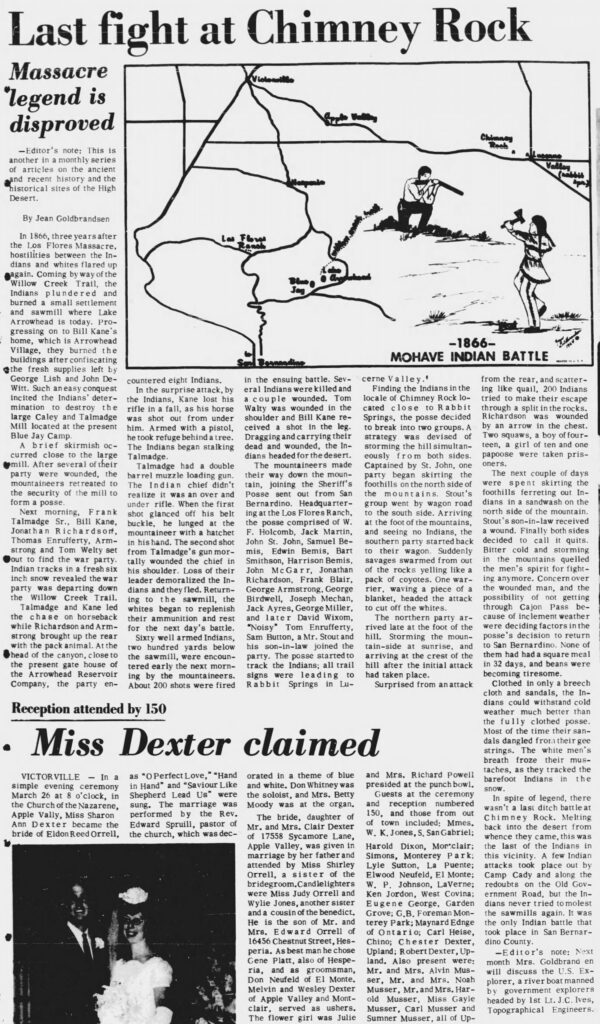
Daily_Press_1964_04_08_9
Some locals later claimed it was a case of mistaken identity, and the small party of Piute Indians that were confronted at Chimney Rock simply snuck out the back way without significant injuries and were never captured. In spite of the legend, there had not been a last ditch battle at Chimney Rock, but it was the only Indian battle that took place in San Bernardino County.
A few Indian attacks took place around Camp Cady and the Government Road in the ensuing years, but the Indians never fought against the sawmills again.
Chimney Rock was designated a California Historic Landmark (No.737) on June 6, 1960. Billy Holcomb Chapter of ECV along with the Lucerne Valley Museum Association and the Lucerne Valley Chamber of Commerce erected historic markers.
Conflicts between Indians and white settlers over the rich lands of the San Bernardino Mountains culminated in the battle at Chimney Rock on February 16, 1867. Although the Indians defended themselves fiercely, they were forced to retreat into the desert. In the years following, the Indians’ traditional mountain food gathering areas were lost to white encroachment.
– Chimney Rock Marker Text
Bonus trivia! In 1931, John, William and Frank Talmadge bought the Las Flores Ranch in Summit Valley with consolidated properties, including the Dunlap Ranch, from the R.F. Garner estate following weeks of negotiation.
The valuable property, comprising of 4,900 acres together with improvements and 800 head of stock was sold for a consideration of $80,000 dollars.
Coordinates for Chimney Rock: N 34° 27.000 W 117° 00.240
11S E 499632 N 3812052
Note: All photos were taken by John Earl exclusively for The Desert Way.
Further Reading
Lazenby, Cindy Chimney Rock By Cindy Lazenby
Historical Landmark CHL # 737 Chimney Rock San Bernadino
Historical Marker The Last Indian Fight in Southern California Historical Marker
California State Parks CHIMNEY ROCK
Cattle Drives of the I S Ranch: Mountains to Desert – The Desert Way with Jaylyn and John
Wilbur’s Grave: Death and Taxes in Belleville – The Desert Way with Jaylyn and John