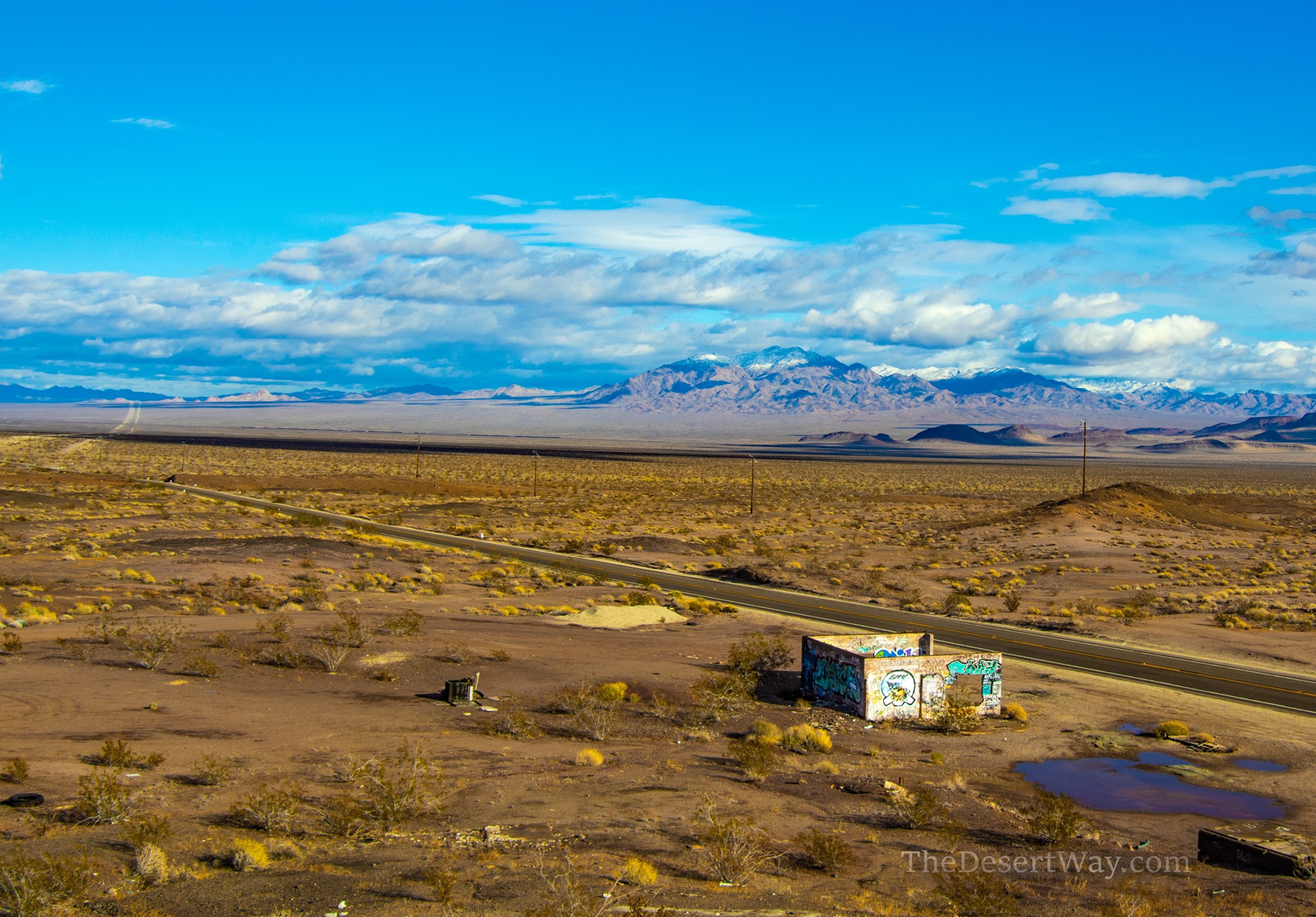
The Bristol Mountains rise between Ludlow and Kelbaker Road like a long, sun‑scorched barricade, the kind of range that looks less formed than forged.
On one side, Route 66 snakes past in its slow, nostalgic way, carrying the ghosts of road‑trippers and the last stubborn believers in Americana.
On the other side of that big ol’ mountain, Interstate 40 hums with the cold efficiency of the modern world, a river of asphalt that doesn’t bother to look back.
Is this important? Maybe so. Out here, the desert draws its own borders, and sometimes the story you’re chasing depends entirely on which side of the mountain you’re standing.
Every mountain has a story to tell, so you might wanna file the following information in your field folder under, ‘Dumb things my government almost did.’
It’s a good one, we promise.
In 1962, the Atchison, Topeka and Santa Fe Railway began planning a new railway between Needles and Barstow through the Bristol mountains in California. A straighter, more level route would be 15 miles shorter than the old line, shaving 50 minutes off the trip.
In 1963, while Interstate-40 was under slow and costly construction, and while Route 66 was still the undisputed way to travel, the Federal Government under President Kennedy had a plan. Now I don’t know about the rest of y’all, but when the Feds have a plan, Murphy’s Law pays attention.
The plan evolved in what was came to be known as, “Project Carryall,” and it promised to save time and money in the construction of the interstate, using a novel 20-year-old technology.
A fly on the wall of the planning committee most likely heard something like this exchange: “Hey, I have an idea! Lets bury TWENTY-TWO NUCLEAR BOMBS, with 100 times more power than the Hiroshima bomb, and blow that damn mountain away!”
We’d like to tell you that the other planners, and by then President Lyndon B. Johnson, might have thought this was just crazy. Insane, in fact! We’d like to say that, but we can’t. The President liked the idea. Congress liked the idea.
Now some of you might remember elementary school in the 1960s. The standard drill for a nuclear bomb blast was to crouch under your desk and tuck your head in real tight. It was an age of innocence.
In 1963, a feasibility study for Project Carryall was implemented under the aegis of the experimental Operation Plowshare project that began in 1957.

Photo courtesy of Columbia Pictures
1964 was also the year that the blockbuster film, “Dr. Strangelove, How I Learned to Stop Worrying and Love the Bomb,” was released. The political satire movie, written, produced and directed by Stanley Kubrick, was based on a thriller novel Red Alert written by Peter George in 1958.
Just an aside.
Anyway, since we all drive on both Interstate-40 and The Mother Road, it’s pretty clear that the project was cancelled, and regular old dynamite was used to clear a little of the Bristol Mountains.
Here’s the scary part, though. It wasn’t cancelled because more rational heads prevailed. No! It never came to be because the money was needed elsewhere, in a country called Vietnam.
So, enjoy your non-irradiated drive down Route-66 sometime soon, and have a great New Year.

Top Photo: John Earl
Resources