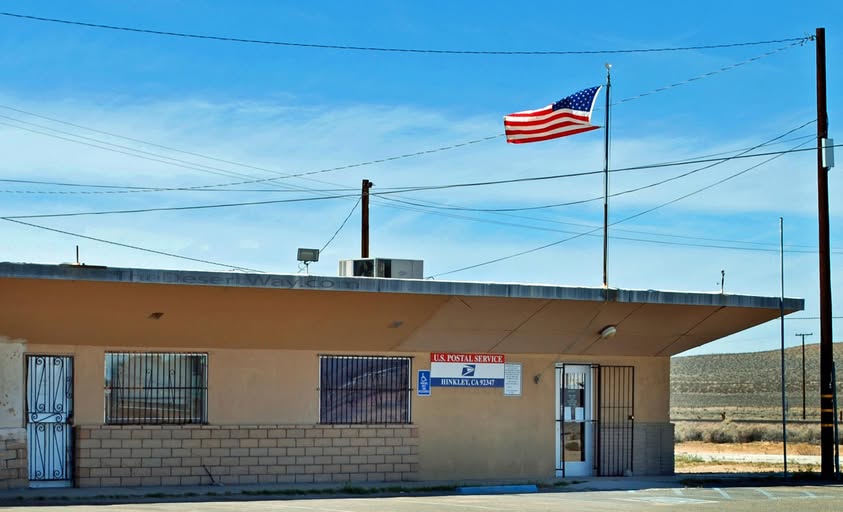
On March 20, 2015, the Stars and Stripes rose over the Hinkley Post Office for the very last time. We stood there as the flag came down, marking the end of a chapter for the tiny desert town 14 miles west‑northwest of Barstow. Hinkley’s post office had been serving residents since 1908, but like much of the community, it was eventually purchased by PG&E and closed its doors for good at the end of business that day.
The town itself has been slowly slipping toward ghost‑town status, its name forever tied to the Erin Brockovich story that exposed PG&E’s contaminated water and the devastating health effects that followed. And as the sun dropped behind the desert hills, the empty flagpole stood like a monument to everything the town had endured.
There is a stark divide in the memory of Hinkley, two eras separated by an invisible fault line. There was the before, when life moved with the quiet rhythm of a desert town, when families drew water from their wells without a second thought, and the horizon felt steady and familiar. And then came the after, after chromium‑6 was found in the groundwater, after the truth surfaced, after the fight began.
It’s as if the town’s story cracked in half. On one side lies the Hinkley people remember with warmth; on the other, the Hinkley shaped by contamination, lawsuits, and the long shadow of PG&E. The contrast is so sharp it feels like stepping from sunlight into a darkened room, your eyes need a moment to adjust before you can even understand what changed.
That dichotomy still lingers in the air, woven into every abandoned building and every story told by those who left and who stayed.
From 1952, Hinkley has had its groundwater contaminated with hexavalent chromium by a compressor station for natural gas transmission pipelines.
At the height of the Hinkley, California contamination crisis in the 1990s, hexavalent chromium (chromium-6) levels in groundwater near the PG&E compressor station exceeded 1,000 parts per billion (ppb). While average levels were much lower, some specific wells read up to 580 ppb or as high as 1,500 ppb in some samples.
Under the auspices of Masry & Vititoe law firm, residents of Hinkley eventually filed a class action lawsuit against Pacific Gas and Electric (PG&E). Their successful lawsuit was the subject of the Oscar-winning film, Erin Brockovich (2000).
Hinkley is more than a headline or a Hollywood script though. It’s a story carried by the people who lived there, families who built lives in the desert, who raised children under the wide Mojave sky, who trusted their wells and their land long before anyone whispered about deceit and contaminated water.
Hinkley owes its name to early settler D.C. Henderson, who christened the place in 1882 after his son, Hinckley Henderson, a tribute that eventually shed its extra c as the town grew. When the Santa Fe Railroad arrived in 1902, it planted the Hinkley Depot at the heart of the community, a bustling outpost that stood for half a century before disappearing from the landscape in 1952.
The first school in Hinkley opened its doors in 1902, marking the beginning of organized education in the small desert community. As the town grew, a new schoolhouse rose in 1921 and served local families for three decades. In 1951, students moved into a more modern campus at 37600 Hinkley Road, which became the Hinkley Elementary/Middle School. After generations of students passed through its halls, the school ultimately closed in 2013 as enrollment steadily declined.
Buildings may fade but memories remain, even in March of 2026.
Anthony Gomez recalled, “I lived with my grandparents about 5 houses north of the school on Hinkley Road. We used to walk here to get water from the water tank back in the day, if I remember, the door to left was a Bar.”
Sven Stahl said, “I lived a few blocks away, this was my local store and post office. I can’t believe it’s all gone now, along with many other things and homes. Then the new 58 completely bypassed the old 2 lane.” He now loves living in Newberry Springs.
Autumn Moore stated, “Grew up there. Four generations of my family live there…my youngest brother is sick from the water.”
Karen Kay Burns Dodd added, “Worked at that post office until they shut it down. Then was transferred to Barstow. Sure miss the place.”
Kenny Childs commented, “Went to the school across the tracks, kindergarten to 8th. And we got to go the library next to it. Heartbreaking to see it all now.”
Allen Sabo said, “I know that area very well, liquor store was next door. Retired from BNSF, and that was my territory up till 2024.”
According to Derek Nepote, “I grew up next door to the Hinkley bible church, my grandma Livingston work at this post office.”
Laura Patty shared, “I worked at the Hinkley Elementary School for 8 years and they always told us the plume didn’t reach there then they found out it did and tore down the post office, the store, the gas station, and the elementary school. I wonder how many kids were inflicted with coronium 7 while they drink from the faucets of the school in the ’90s. My papaw had a big house and a little farm on Rainbow Road at the end of Community Boulevard they swore the plume didn’t reach there then found out there was a hidden Reservoir and they tore down that whole street of houses. My best friend’s dad was a boss at PG&E in the summertime we swam in the pool all of the time at PG&E in the ’70s. I’m facing many health challenges today because of all of it. Hinkley was a great little farming community as a kid I remember we use to be able to pull up to one of the Farms honk your horn and they would bring out fresh milk and eggs.”
Anne Roark stated, “My dad taught school there before 1971.”
Kathleen Bennett remembered, “I swam in the pool twice. My cousins swam daily. One gone with lymphoma, one with glial brain tumor. They were PG&E kids.”
John Bowler commented, “Two of my friends were from Hinkley and his wife died about 10 years ago from brain cancer from the tainted water. He lost a kidney from this also. After his wife’s death, his family was awarded $20 million. I had gone to dinner with both he and his wife about two weeks before she went into the hospital, complaining of headaches and dying about two months later.”
Gleason Decosta shared, “As a propane delivery and service person..my favorite stop for drinks and snacks..also the sounds of the railway passing by…never drank the water..knew many who did.”
Keith Snyder recalled, “Grandma had a house down the road.”
Dominic Mcling offered, “That’s where I got my passport, such nice and friendly people there always. So sad to see it go.”
Colleen Fletcher added, “My daughter went to school in Hinkley. We lived at Hunt’s old dairy. Drank the water [and] bathed in it. The kids had a kiddy pool. My daughter Lori died from bone cancer.”
We were recently notified chromium-6 is present in the groundwater and tap water in our current city of La Quinta and surrounding areas due to natural geological occurrences. As of late 2025, the Coachella Valley Water District (CVWD) notified customers in certain areas, including La Quinta, that levels exceeded the new 10 parts per billion (ppb) state limit. In November 2025, some water samples showed average levels between 11 and 14 ppb, exceeding the 10 ppb maximum contaminant level (MCL). We have been assured the current levels are safe.
Where have we heard that promise before?
References
Schoffstall, Patricia A., Mojave Desert Dictionary Second Edition, published by Mojave River Valley Museum, Barstow, California, page 145.
Earl, Jaylyn and John, https://facebook.com/thedesertway, March 20, 2026, 10:16 p.m.
